Butterpond-4
The Stars Have EyesButterpond-4 is the fourth planet orbiting the white star Butterpond and the homeworld of Joe Mulligan. It is a prosperous but intensely urbanized colony within the 3rd British Empire, whose material abundance, virtual entertainment systems, transportation networks, and wormhole infrastructure make everyday life appear utopian while concealing severe social dependence on automated and highly specialized systems.
Planetary Setting and Political Context
Butterpond-4 is one of eighty-six systems ruled by the 3rd British Empire, commonly called 3BE, which itself belongs to the Federation of Allied Governments. Its global population is approximately seventeen billion, with mega-city Dave-156 alone containing about one third of that total. The scale of Dave-156 makes Joe an anonymous face among immense populations, at least until his encounter with Maggie changes his position within the world.
The planet is life-sustaining but did not develop an indigenous ecosystem. When British colonists arrived, they populated it with Earth-based plants and animals as part of their terraforming efforts. This distinction becomes visible during travel across the planet: areas near the cities are densely settled and technologically managed, while a large tropical jungle remains relatively untouched by industry. To Maggie, the transplanted flora and fauna are still worth studying because she has not examined humanity’s homeworld in depth, even though most residents would regard the organisms as ordinary.
Economy and Urban Society
Butterpond-4 is rich in rare minerals and metals, and its automated workforce converts those resources into immense profit. That wealth supplies the residents of its mega-cities with food, water, clothing, shelter, medicine, and personal safety without requiring most people to hold conventional employment. The result resembles a post-scarcity utopia, but the abundance is paired with densely packed living conditions and a pervasive dependence on the systems that distribute it.
Employment is exceptionally rare: fewer than 0.1 percent of the population enjoys the benefits of a steady job. Work therefore functions as a mark of prestige rather than a normal means of survival. Greg’s employment helped him recruit people into the Cult of the Gazing Star because gainful employment made him appear important in a society where almost everyone else relied on state provision. Joe receives a tiny state apartment, a monthly allowance, and a Full Immersion Pod 3,000™; in exchange for those seemingly meager benefits, he must salute the picture of the Eternal God-Queen at least once every twenty-four hours.
This arrangement exposes the political cost of material abundance. Basic necessities are available, but autonomy is narrower than the comfort of the society suggests. Joe’s home is small, his movement and entertainment are mediated by public infrastructure, and even his obligations to the state are reduced to a ritualized daily gesture. The system frees most citizens from labor while also making them dependent on institutions they do not control.
Cities, Transport, and Virtual Life
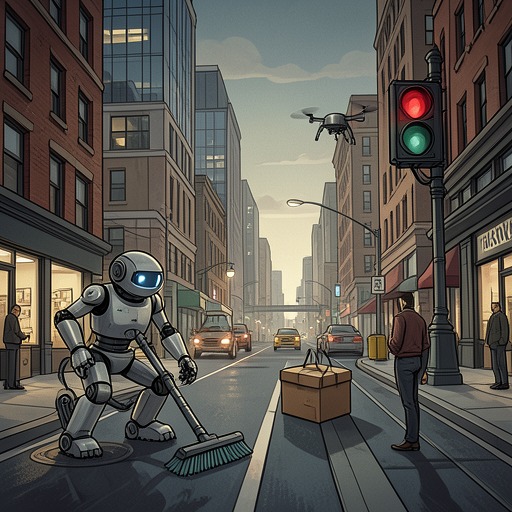
Dave-156 is the main urban environment associated with Butterpond-4. Its vast streets contain so many people that an ordinary resident can disappear into the crowd, yet Maggie’s unusual appearance immediately attracts attention when she walks through them wearing the skin of a pale young girl. Her presence contrasts with the city’s normality: the setting is familiar enough for public transit, apartments, pubs, and online services, but her cosmic nature turns those ordinary spaces into sites of observation.
The V-Life network absorbs much of the pressure created by the mega-cities’ density. It supplies an enormous volume of digital entertainment, addressing humanity’s demand for distraction once basic needs have been fulfilled. Maggie finds the system especially valuable because it gives her access to paintings, books, stage plays, video games, sculptures, cuisine, fashion, and other forms of human expression. Although the material is digital, she considers that condition irrelevant to its artistic merit; the sheer quantity of available media could occupy even her vast intellect for centuries.
The planet’s transport system links its urban centers through flying taxis, tube stations, and supersonic inter-city trains. Dave-157, a smaller mega-city approximately two thousand kilometers from Dave-156, can be reached by taxi and train. The trains travel through vacuum-sealed tunnels on magnetic rails, achieving supersonic speeds with exceptional efficiency. Their routes also reveal the contrast between civilization and the remaining wilderness: the later part of one journey crosses a tropical jungle whose life has been left largely undisturbed by industry.
Butterpond-4 also contains Amelia-10, a resort extending roughly one hundred and thirty kilometers along the beach. Its popularity makes reservations nearly impossible for six months, but Maggie’s diplomatic status allows her and Joe to use hotel rooms reserved for foreign dignitaries at government expense. The visit places the couple in a rare natural setting, where Joe confronts his insecurity among physically perfected vacationers and where Maggie’s anomalous sandcastle is destroyed by Agent Sarah Johanson. The trip later has an unintended planetary consequence when photographs and videos of Maggie in a black-and-red bikini circulate online and trigger a copyright complaint from Melinda Sparklestar over the appearance she has supposedly stolen.
Infrastructure, Risk, and Reality Damage
Butterpond-4’s prosperity depends on infrastructure that is powerful enough to reshape both society and reality. Wormhole generators create and sustain artificial black holes while producing counter-gravitational fields to protect vessels. Their energy output would instantly liquefy living creatures within a hundred kilometers without extensive shielding and countermeasures. On the ICF-M42 Trafalgar, layers of radiation and energy shielding around the generator even block Maggie’s ability to peer through solid matter, despite not being designed specifically to obstruct psionics.
Maggie identifies the generators as the cause of the breach events that the Supernatural Eviction Agency has observed increasing in frequency and severity for roughly three hundred years. Those events are especially common in heavily populated systems such as Butterpond-4. Her diagnosis reframes the planet’s technological civilization: the same infrastructure that enables interstellar mobility and economic expansion is also damaging the fabric of reality. The danger is not an isolated malfunction but a systemic consequence of the devices on which the wider political order relies.
The contradiction is central to Butterpond-4’s character as a setting. Automated mining creates abundance, virtual networks absorb attention, and high-speed transit compresses distance, yet the planet’s most advanced systems generate hidden risks that ordinary citizens cannot perceive or repair. Maggie’s new obligation to the Third British Empire is partly to make its interstellar vessels less damaging to reality, turning her cosmic perspective into a form of technical and political oversight.
Narrative Significance
Butterpond-4 begins as an anonymous homeworld in Joe’s life and becomes the principal testing ground for Maggie’s attempt to understand humanity. She studies its streets, housing, media, transportation, wildlife, fashion, food, and social conventions while Joe serves as her guide and anchor. Her contract binds her to protect and nurture his fragile being, while he helps her interpret a civilization that she could otherwise observe only from outside.
The planet’s ordinary surfaces repeatedly conceal extraordinary tensions. A tiny apartment represents both guaranteed welfare and limited independence; a leisure network represents artistic abundance and social dependence on mediated experience; a tropical jungle represents preserved life that exists only because colonization imported it; and a wormhole generator represents technological mastery coupled with structural damage. Butterpond-4 therefore functions not merely as a backdrop but as the material argument of the story: a society can overcome scarcity while remaining vulnerable to infrastructure, institutional power, and consequences hidden beneath apparent convenience.